
Severe pain + fever + reduced urine output + known hydronephrosis is an emergency.
Obstructed kidneys can become infected (called pyonephrosis) — this is a life-threatening urological emergency requiring same-day decompression. Call us or go to the nearest ER if you have these symptoms.
📞 Call Emergency LineWhat is
hydronephrosis?
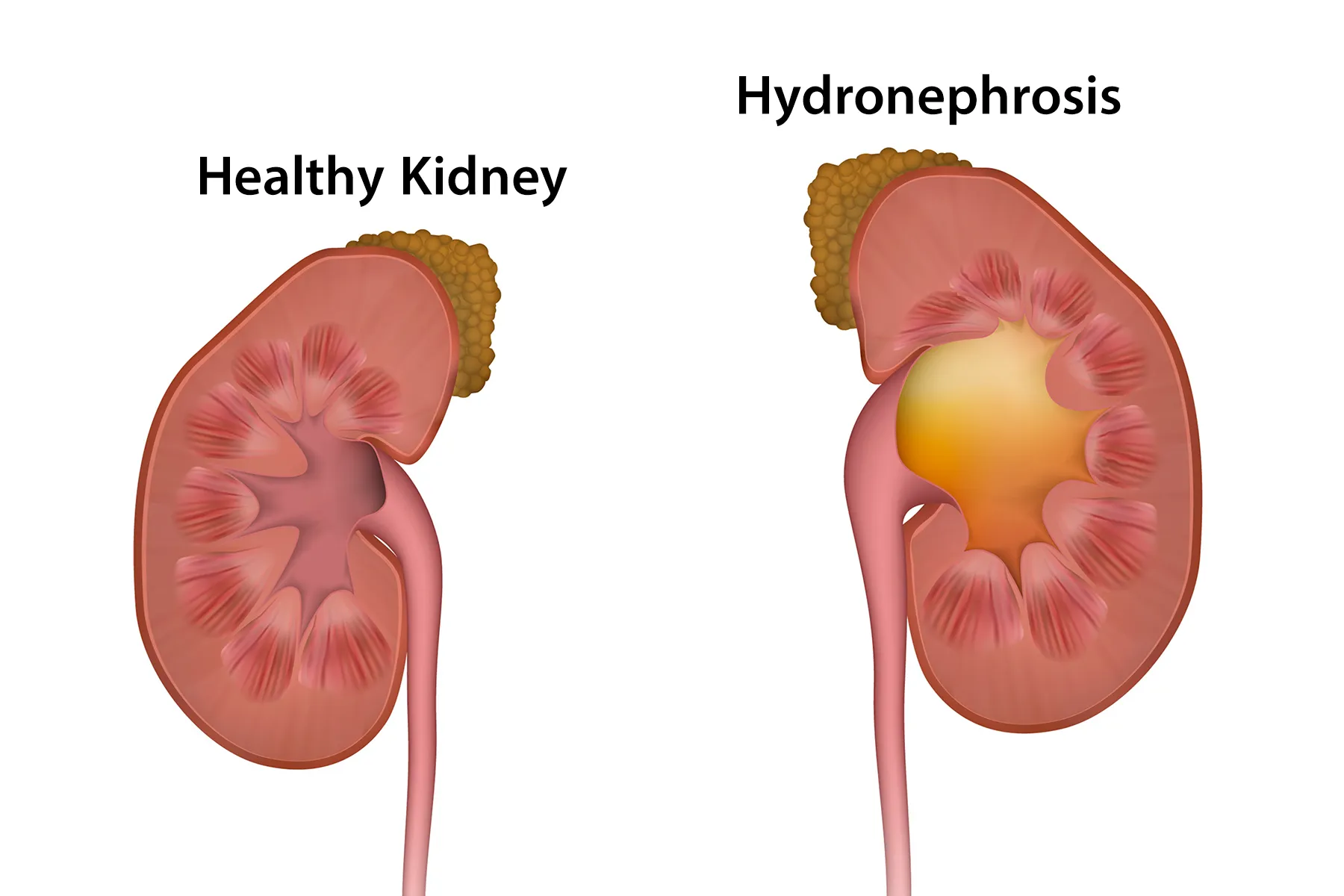
Hydronephrosis is the medical term for swelling of the kidney's collecting system — the renal pelvis and calyces — because urine isn't draining out properly. The kidney is, in effect, a balloon that has filled up with fluid it should have already passed downstream.
The important thing to understand: hydronephrosis is not a disease, it is a finding. It tells us something is obstructing the flow of urine, but it doesn't tell us what. A 5 mm kidney stone wedged in the ureter, a pelvic-ureteric junction narrowing, an enlarged prostate, a tumour pressing on the ureter, scar tissue from prior surgery, or even a normal anatomical variant — all can produce hydronephrosis. The treatment depends entirely on the cause.
The other important thing: chronic, untreated hydronephrosis damages the kidney. The pressure of trapped urine gradually compresses the kidney tissue, reducing the number of functioning nephrons. Mild hydronephrosis caught early is fully reversible. Severe long-standing hydronephrosis may leave permanent damage even after the obstruction is relieved.
Four grades —
each with a different plan.
Slight dilation
The collecting system is mildly swollen but the kidney tissue looks normal. Often picked up incidentally on ultrasound. Cause needs identification but urgency is low.
Calyces dilated
The pelvis and calyces are clearly dilated but the kidney tissue (parenchyma) is still preserved. Cause needs investigation and likely treatment within weeks.
Parenchyma thinning
The kidney tissue is starting to thin from pressure. Function may be compromised. Treatment needs to be planned within days.
Marked thinning
Significant parenchymal thinning and severe dilation. Permanent damage likely if not relieved promptly. Often needs urgent decompression with a stent or nephrostomy.
What blocks
the kidney from draining.
Causes of hydronephrosis fall into two categories — depending on where the blockage is.
Upper-tract causes (kidney and ureter):
- Kidney stones — by far the most common cause we see in Jaipur. A stone wedged in the ureter immediately backs urine up into the kidney.
- Pelvi-ureteric junction (PUJ) obstruction — a narrowing where the kidney joins the ureter. Often congenital, sometimes acquired. Can present in children or adults.
- Ureteric stricture — scarring of the ureter from past surgery, radiation, instrumentation, or tuberculosis.
- Tumours — of the ureter, kidney, or adjacent structures pressing on the ureter.
- Retroperitoneal fibrosis — uncommon condition where scar tissue traps the ureters.
- Pregnancy — the enlarging uterus can cause mild bilateral hydronephrosis (usually resolves after delivery).
Lower-tract causes (bladder and below):
- Benign prostatic hyperplasia (BPH) — severe BPH can back urine up so far it dilates both kidneys. Common cause of bilateral hydronephrosis in older men.
- Bladder outlet obstruction — bladder neck contracture, urethral stricture.
- Neurogenic bladder — high-pressure bladder from neurological disease (spinal cord injury, multiple sclerosis, diabetes).
- Bladder cancer — particularly if invading the ureteric openings.
- Pelvic tumours — gynaecological, colorectal cancers pressing on the bladder or ureters.
From silent finding
to acute pain.
Hydronephrosis can be entirely silent or dramatically painful — depending on whether it developed slowly or suddenly.
Acute hydronephrosis — from a stone blocking the ureter, for example — causes the classic renal colic. Sudden severe one-sided flank pain, nausea, blood in urine, restlessness. The pain is among the most severe in medicine.
Chronic hydronephrosis — from BPH, slow-growing tumour, or congenital narrowing — often has no symptoms at all. The kidney swells gradually and the body adapts. It may be discovered incidentally on an abdominal ultrasound, or only when blood tests show elevated creatinine.
Symptoms that should prompt evaluation:
- Dull or persistent one-sided flank pain
- Recurrent UTI affecting the same kidney
- Blood in urine
- Difficulty urinating or weak stream (suggests lower tract cause)
- Unexplained rise in creatinine on a routine check
- Hypertension that is hard to control (in some cases)
- Fever with flank pain in someone known to have hydronephrosis — emergency
Finding the
cause of the swelling.
The diagnosis of hydronephrosis itself is usually straightforward — an ultrasound shows it. The work is in finding why.
- Ultrasound KUB — first-line, no radiation, confirms hydronephrosis and grades severity. Often shows the cause if it's a Stone or large prostate.
- NCCT KUB — gold standard. Identifies stones (even small ones), strictures, masses, anatomical abnormalities.
- Blood tests — creatinine and urea to assess kidney function. The split between affected and unaffected kidney can also be estimated.
- Urine analysis & culture — to rule out infection.
- DTPA renal scan — measures the function of each kidney separately and shows whether the obstruction is significant (functional obstruction vs incidental dilation).
- Cystoscopy with retrograde pyelogram — in selected cases, to directly visualise strictures or tumours.
- CT urogram or MR urogram — for complex anatomical assessment.
By the end of the workup, the answer to two questions should be clear: what is causing the obstruction, and how is kidney function affected. That determines treatment.
Two priorities —
relieve the pressure, fix the cause.
DJ Stent
A soft tube placed through the urethra, bladder, and ureter into the kidney to allow drainage. Done endoscopically. The fastest way to relieve acute obstruction.
Percutaneous Nephrostomy
A small tube placed directly into the kidney through the back skin, under ultrasound or X-ray guidance. Used when ureter access is impossible or when the kidney is severely infected.
Stone Removal
Definitive treatment when a stone is the cause — RIRS, URS, or PCNL depending on size and location. Often done after initial stent placement allows the kidney to recover. Stone treatment →
Pyeloplasty
Surgical correction of PUJ obstruction. Done laparoscopically or robotically. Reconstructs the narrowed segment. Excellent long-term outcomes.
Ureteroplasty / Reimplantation
Reconstruction of strictured ureter segments. Sometimes uses tissue from the bladder or even mouth lining.
TURP / HoLEP + Bladder Drainage
If hydronephrosis is from BPH, treating the prostate addresses the cause. Catheter drainage first, then definitive surgery. Prostate treatment →
Diagnose the cause.
Treat once.
Protect the kidney.
Same-week imaging access
Hydronephrosis identified on a basic ultrasound gets a full workup quickly — NCCT, DTPA, blood work — usually within a week.
Emergency decompression capability
Severe or infected hydronephrosis needs same-day stent or nephrostomy. We do both at the clinic.
Definitive surgery available
Stone removal, pyeloplasty, BPH surgery — the underlying causes are treated under one roof, with the same surgeon.
Function-first approach
Every decision is calibrated to preserve kidney function. Drainage first, definitive surgery second, with function reassessment between.
Pricing for
hydronephrosis care.
| Service | Starting from |
|---|---|
| Consultation | ₹ [____] |
| Ultrasound KUB | from ₹ [____] |
| NCCT KUB | from ₹ [____] |
| DTPA renal scan | from ₹ [____] |
| Emergency DJ stent | from ₹ [____] |
| Percutaneous nephrostomy | from ₹ [____] |
| Laparoscopic pyeloplasty | from ₹ [____] |
| Stent removal (OPD) | from ₹ [____] |
Cashless treatment with all major insurers.
All procedural treatment for hydronephrosis — stenting, nephrostomy, pyeloplasty, stone surgery — is covered by major insurers. We handle pre-authorisation.
Hydronephrosis —
your questions.
It depends on the grade, the cause, and how long it has been there. Mild incidental hydronephrosis may need only observation. Severe hydronephrosis with infection needs same-day treatment. The first step is finding the cause — usually with an NCCT KUB.
Yes — chronic untreated hydronephrosis gradually destroys functional kidney tissue. The earlier the cause is relieved, the better the chance of full recovery. Severe long-standing hydronephrosis may leave permanent damage even after treatment.
Often yes, partially or fully. Recent acute hydronephrosis usually fully recovers. Chronic moderate hydronephrosis may show partial recovery. Severe long-standing hydronephrosis may leave permanent reduction in function — though the kidney often still contributes to overall function.
Usually not. Pregnancy-related hydronephrosis is very common — the enlarging uterus compresses the ureters, causing mild dilation. It almost always resolves after delivery. We do recommend a check 3 months post-delivery to confirm resolution.
A DJ stent is a soft tube placed inside the ureter to keep urine flowing past an obstruction. Used either as temporary relief before definitive surgery (e.g., stone removal) or sometimes long-term where definitive surgery isn't possible. Removed at a brief outpatient procedure.
A DTPA scan can quantify exactly how much function each kidney retains. If the affected kidney contributes less than 10–15% of overall function, removing it (nephrectomy) may be safer than trying to save it — particularly if it's causing infection or hypertension. If function is preserved, we focus on relieving the obstruction.
Yes — laparoscopic pyeloplasty for PUJ obstruction is performed at Kalra Endo-Uro Care. Minimally invasive, smaller incisions, faster recovery than open surgery. Outcomes equivalent to open pyeloplasty in experienced hands.
Yes — all major Indian health insurers cover diagnostic imaging, stent placement, nephrostomy, and definitive surgery for hydronephrosis. We handle pre-authorisation paperwork.
