
Sudden severe one-sided back/side pain plus fever, vomiting, or no urine output — go to ER or call us immediately.
Ureter stones with infection or complete obstruction are an emergency. Don't wait.
📞 Call Emergency LineWhat is
a ureter stone?
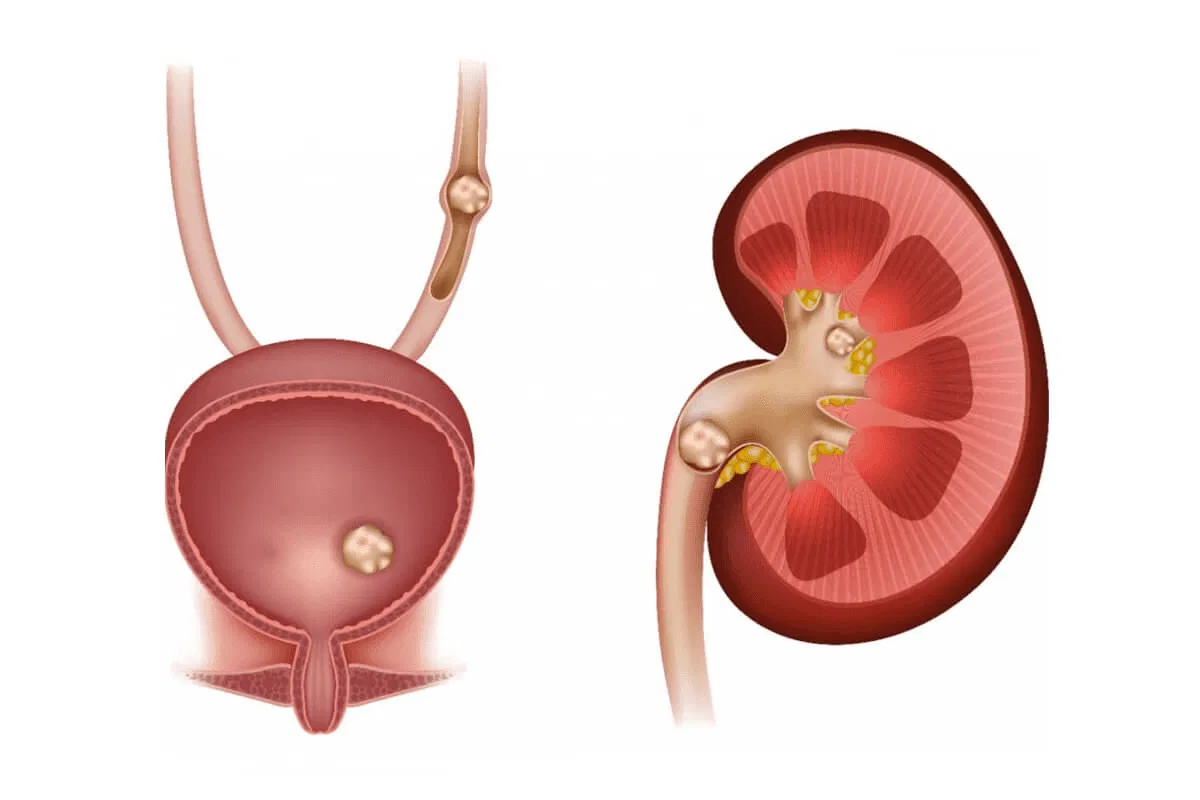
A ureter stone (also called ureteric stone, ureteric calculus, or ureterolithiasis) is a kidney stone that has moved out of the kidney and lodged inside the ureter — the narrow muscular tube that carries urine from the kidney to the bladder. The ureter is typically only 3–4 mm in diameter, which is why stones that pass easily through the kidney can become stuck in the ureter and cause severe symptoms.
Ureter stones almost always originate in the kidney. The chemistry is identical — calcium oxalate, uric acid, struvite, or cystine. What changes is the location: the moment a stone enters the ureter, the body interprets the obstruction as a crisis, and the result is the classic ureteric colic.
How a ureter stone
announces itself.
- Sudden severe one-sided pain from back to lower abdomen — comes in waves, often making the person restless and unable to sit still.
- Pain radiating to the groin, scrotum (in men), or labia (in women) as the stone descends.
- Nausea and vomiting — usually accompanies the pain.
- Blood in the urine — visible or detectable on dipstick.
- Frequent urge to urinate with little output — particularly when the stone is in the lower ureter near the bladder.
- Fever, chills, or no urine output — these are red flags requiring urgent care.
The ureter has
three pinch points.
Where the stone gets stuck affects symptoms and treatment access.
Pelvi-ureteric junction
Where the kidney meets the ureter. Stones here often need RIRS or push-back to the kidney with subsequent laser fragmentation.
Crossing the iliac vessels
The middle portion where the ureter crosses the iliac blood vessels. Standard URS with laser is usually possible.
Vesico-ureteric junction
Just before the bladder — the narrowest natural point. Most accessible with URS. Stones here cause maximum bladder irritability.
Both ureters
Rare but dangerous. Bilateral obstruction can cause acute kidney injury and needs urgent decompression with stent placement.
Three options.
Matched to your stone.
| Treatment | Best for | Anaesthesia | Stay | Recovery | Cost |
|---|---|---|---|---|---|
| Medical Expulsive TherapyMET | Stones < 5 mm, no infection | None | None | 2–4 weeks | ₹ |
| URSUreteroscopy + laser | Stones 5–15 mm in ureter | General / spinal | Same day or next | 3–5 days | ₹₹₹ |
| RIRSFor impacted upper stones | Upper ureter / push-back stones | General / spinal | Same day or next | 3–5 days | ₹₹₹ |
Medical Expulsive Therapy (MET) works for small ureter stones under 5 mm with no infection. Tamsulosin (an alpha-blocker) relaxes the ureteric muscle, combined with hydration and pain relief. Most small stones pass within 2–4 weeks.
Ureteroscopy (URS) with laser is the workhorse procedure for ureteric stones from 5 to 15 mm. A thin rigid or semi-rigid scope is passed through the urethra and bladder up to the stone. A Holmium or Thulium Fiber laser fragments the stone, and the pieces are removed. No external cut. Typically same-day or next-day discharge.
RIRS is used when the stone has migrated back up into the kidney or when access through the ureter is difficult. The flexible scope reaches further up and can be combined with laser fragmentation.
Specialist care
for the most painful
stone disease.
Latest laser arsenal
Holmium and Thulium Fiber laser — faster fragmentation, less heat damage.
Flexible & semi-rigid scopes
We choose the right scope for the stone, not the only one we own.
24-hour emergency triage
Severe ureteric colic with fever or no urine is an emergency — call us first.
Same-day surgical capacity
Most ureter stones can be operated within 24–48 hours of presentation.
Transparent pricing for ureter stone treatment.
| Procedure | Starting from |
|---|---|
| Consultation | ₹ [____] |
| Medical Expulsive Therapy (per cycle) | ₹ [____] |
| URS with laser | from ₹ [____] |
| RIRS (for impacted stones) | from ₹ [____] |
| Emergency stent placement | from ₹ [____] |
| Stent removal | from ₹ [____] |
Cashless treatment with all major insurers.
Most CGHS / ECHS / PSU panels supported. We handle pre-authorisation paperwork for you. Call +91 9509370455 for a personalised estimate. EMI options available for self-pay patients.
Ureter stones —
your questions.
Yes — most ureter stones under 5 mm pass within 2–4 weeks with medical expulsive therapy. Stones 5–10 mm pass about 30–50% of the time. Larger stones usually need URS.
Ureteric colic is consistently ranked among the most severe pains in clinical medicine. Pain comes in waves and often makes the patient unable to sit still.
A thin scope is passed through the urethra and bladder up to the stone. A laser fragments the stone, and the pieces are removed. No external incision. Done under general or spinal anaesthesia.
A DJ stent keeps the ureter open while it heals from instrumentation and stone trauma. It's not usually painful and is removed at a brief outpatient procedure 2 weeks later.
Most cases can be operated within 24–48 hours of consultation. Emergency cases (with fever or obstruction) can be operated same-day.
Without prevention, about half of stone formers have another stone within 5 years. We send every retrieved stone for analysis and build a personalised prevention plan.
Yes — covered by all major Indian health insurers with cashless TPA partners. We handle pre-authorisation.
