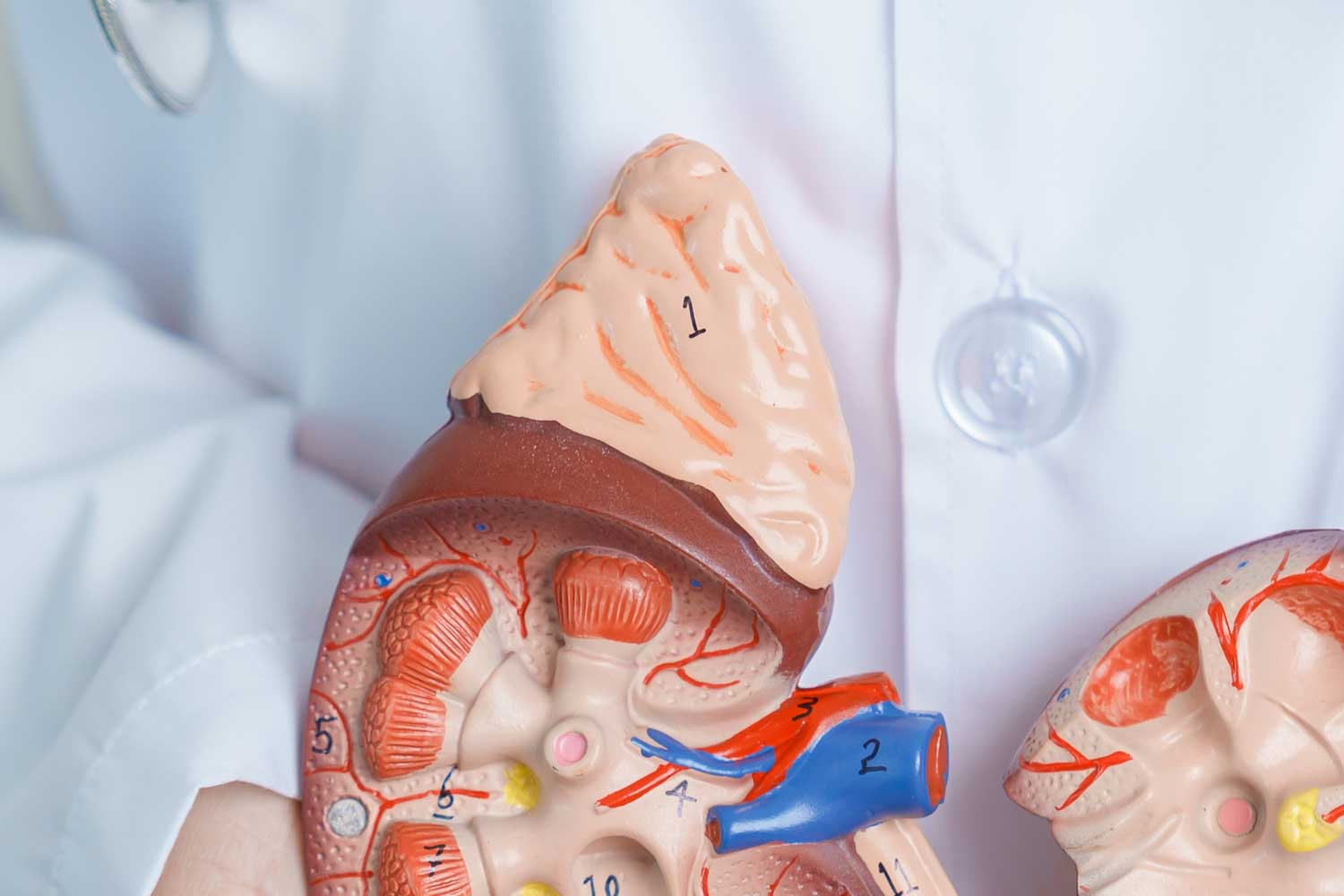
What are the
adrenal glands?
The adrenal glands are two small triangular organs that sit on top of each kidney, one on each side. Each weighs only about 5 grams — barely the size of a thumbnail — yet they produce some of the most important hormones in the body: cortisol (regulates stress, metabolism, immune function), aldosterone (controls blood pressure and electrolytes), adrenaline and noradrenaline (the fight-or-flight hormones), and small amounts of androgens.
An adrenal tumour is any abnormal growth in one of these glands. The word "tumour" sounds alarming, but in the adrenal context it spans a wide range — from completely benign, hormonally silent nodules that need no treatment, to hormone-producing tumours that quietly cause years of unexplained symptoms, to (uncommonly) malignant cancers that need urgent surgery.
What changed adrenal medicine over the past two decades is imaging. Routine CT scans for unrelated reasons — kidney stones, abdominal pain, road traffic accident workup — now uncover adrenal lesions in roughly 5% of adults. Most are entirely incidental and harmless. But each one has to be evaluated, because that small percentage that aren't harmless need finding.
Three categories.
Each behaves differently.
Non-functioning adenoma
A benign, hormonally silent nodule. Doesn't cause symptoms. Most adrenal incidentalomas fall here. Usually need only surveillance imaging, not surgery — provided imaging features are reassuring.
Cortisol-producing (Cushing's)
Produces excess cortisol. Causes weight gain (central), high blood pressure, easy bruising, muscle weakness, diabetes, mood changes, thin skin. Symptoms can be subtle for years before diagnosis.
Aldosterone-producing (Conn's)
Causes resistant hypertension (often in younger patients) and low blood potassium. Often missed because the BP just looks like "ordinary hypertension." Removal can cure the BP entirely.
Pheochromocytoma
Produces adrenaline/noradrenaline. Causes episodic spikes in blood pressure, headaches, sweating, palpitations, anxiety. Diagnosed by 24-hour urine metanephrines. Surgical removal needs careful pre-op preparation.
Adrenocortical Carcinoma (ACC)
The malignant adrenal cancer. Aggressive but rare. Larger tumours (over 4–6 cm) and certain imaging features raise suspicion. Needs prompt surgical removal at a centre with oncological experience.
Adrenal Metastasis
Cancer from elsewhere (lung, breast, kidney, melanoma) that has spread to the adrenal. Identified by knowing the patient has cancer elsewhere, or by biopsy in selected cases.
What functional
adrenal tumours feel like.
Most adrenal tumours are silent. The ones that aren't produce specific syndromes based on which hormone is being overproduced:
Cortisol excess (Cushing's syndrome):
- Weight gain, especially around the abdomen and face ("moon face")
- Purple stretch marks (striae) on abdomen or thighs
- Easy bruising, thin fragile skin
- Muscle weakness, particularly thighs and shoulders
- High blood pressure (often resistant to standard medication)
- Diabetes or pre-diabetes
- Mood changes, irritability, depression
- Irregular periods in women, reduced libido in men
- Slow wound healing, frequent infections
Aldosterone excess (Conn's syndrome):
- Hypertension that requires multiple medications or doesn't respond well
- Low blood potassium (sometimes causing weakness, cramps)
- Headaches
- Often diagnosed in patients under 50 with severe hypertension
Catecholamine excess (Pheochromocytoma):
- Episodic severe headaches
- Palpitations, racing heart
- Profuse sweating
- Severe BP spikes (sometimes 200+/110+)
- Anxiety attacks that feel "physical"
- Pale, cold extremities during episodes
Two questions —
functional and malignant.
Every adrenal tumour gets the same two questions answered: is it producing too much of any hormone, and could it be malignant?
Hormonal evaluation (functionality):
- Overnight dexamethasone suppression test — screens for autonomous cortisol production. Take 1mg dexamethasone at 11pm, check cortisol at 8am next day. Most accurate single test.
- Plasma aldosterone-to-renin ratio (ARR) — screens for Conn's syndrome. Done in the morning, off certain BP medications where possible.
- 24-hour urine metanephrines or plasma metanephrines — screens for pheochromocytoma.
- DHEA-S — sex steroid screening, particularly if features of androgen excess.
- Blood electrolytes, glucose — patterns suggesting Cushing's or Conn's.
Imaging evaluation (malignant risk):
- Dedicated adrenal CT — measures Hounsfield density (low density = lipid-rich = benign adenoma; high density = needs further evaluation). Size is the other key factor.
- Adrenal MRI with chemical shift sequences — alternative to CT, particularly useful for distinguishing benign adenomas.
- Functional imaging — MIBG scan for pheochromocytomas, FDG-PET in suspected malignancy or metastasis.
Which adrenal tumours
actually need surgery.
Not every adrenal mass needs an operation. The clear surgical indications are:
- Hormonally active (functional) tumours — regardless of size. Cushing's, Conn's, and pheochromocytoma all have a surgical cure.
- Size over 4 cm in younger patients or over 6 cm in older patients — even if non-functional, larger size carries higher malignancy risk.
- Imaging features suspicious for malignancy — irregular borders, heterogeneous content, high density on CT, growth over time.
- Growth on follow-up imaging — a lesion that grows by more than 0.5–1 cm in a year warrants surgery.
- Suspected adrenocortical carcinoma — urgent surgical removal at a centre with oncological experience.
- Adrenal metastasis — selected cases where the primary cancer is controlled and removing the adrenal metastasis offers meaningful benefit.
Surveillance, not surgery, is correct for:
- Non-functional adenomas under 4 cm with reassuring imaging
- Lesions in elderly patients with significant comorbidities, where surgery may risk more than the tumour
The right answer for many patients is structured imaging surveillance — repeat CT or MRI at 6, 12, and 24 months. If stable, intervals lengthen. If growing or developing functionality, surgery is then offered.
Laparoscopic adrenalectomy —
the modern standard.
Laparoscopic Adrenalectomy
Three or four small keyhole incisions in the side or abdomen. The gland and tumour removed via these ports. Most adrenal tumours under 6–8 cm are removed this way. Hospital stay 2–4 days, recovery in 2–3 weeks.
Retroperitoneal Approach
The adrenal is accessed from behind, through the retroperitoneal space, avoiding the abdominal cavity entirely. Useful for selected patients, particularly those with prior abdominal surgery.
Robotic Adrenalectomy
Robotic platforms offer enhanced visualisation and dexterity. Coordinated with partner robotic centres for selected complex cases.
Open Adrenalectomy
Larger incision. Reserved for very large tumours (over 8–10 cm), suspected adrenocortical carcinoma, or where laparoscopic access is unsafe. Recovery longer but oncologically necessary in selected cases.
Pre-operative preparation matters — particularly for pheochromocytoma, which requires alpha-blockade (typically phenoxybenzamine) for 1–2 weeks before surgery to prevent dangerous BP spikes during the operation. For Cushing's patients, perioperative steroid replacement is essential. For Conn's, electrolytes are optimised pre-op. These are not surgeries to rush into without proper preparation.
Workup first.
Surgery when indicated.
Never the other way round.
Structured workup, not rushed surgery
Every adrenal mass gets a proper functional and imaging evaluation. We don't operate on adrenals without knowing what we're dealing with.
Laparoscopic capability
VLD Fellowship in advanced laparoscopy. Most adrenal tumours under 6–8 cm can be removed laparoscopically — smaller scars, faster recovery, less pain.
Endocrinology coordination
Functional adrenal tumours need endocrinology input — pre-op preparation, post-op hormone management. We coordinate with experienced endocrinologists in Jaipur.
Surveillance done properly
For non-surgical incidentalomas, we run a structured surveillance protocol — not "come back if you have symptoms," but planned imaging at the right intervals.
Pricing for adrenal
evaluation & surgery.
| Service | Starting from |
|---|---|
| Consultation | ₹ [____] |
| Hormonal workup (full panel) | from ₹ [____] |
| Dedicated adrenal CT | from ₹ [____] |
| Adrenal MRI | from ₹ [____] |
| Laparoscopic adrenalectomy (unilateral) | from ₹ [____] |
| Open adrenalectomy (selected cases) | from ₹ [____] |
| Pre-op preparation (pheochromocytoma) | from ₹ [____] |
| Surveillance imaging (per scan) | from ₹ [____] |
Cashless treatment with all major insurers.
Adrenal surgery is covered by all major Indian insurers. Hormonal workup and surveillance imaging are usually covered when clinically indicated. We handle pre-authorisation paperwork.
Adrenal tumours —
your questions.
Almost certainly not. About 85% of incidentally-found adrenal masses are benign non-functioning adenomas — no treatment needed beyond imaging follow-up. The workup answers two questions: is it producing too much of any hormone, and does it look benign on dedicated imaging? Both usually take one or two visits.
As a general guide: tumours over 4 cm in younger patients or over 6 cm in older patients warrant surgery, even if non-functional, because malignancy risk rises with size. Any hormone-producing tumour needs surgery regardless of size. Lesions that grow on follow-up imaging also need surgery.
If only one adrenal is removed (the usual situation), the other adrenal compensates fully — no long-term hormone replacement needed. If both adrenals are removed (rare), lifelong cortisol and mineralocorticoid replacement is essential. Cushing's patients may need short-term steroid replacement after one-sided surgery while the suppressed normal adrenal recovers.
Hospital stay typically 2–4 days. Most patients return to desk work in 10–14 days. Gym and heavy lifting at 4–6 weeks. Recovery is dramatically faster than from open adrenal surgery.
Medical therapy can control symptoms — for example, spironolactone for Conn's, ketoconazole for Cushing's, alpha-blockers for pheochromocytoma. But long-term control of a hormone-producing adrenal tumour is generally surgical. Medical therapy is used for pre-op preparation or when surgery isn't possible.
Possibly. Resistant hypertension (needing three or more BP medications), particularly in patients under 50, or with low potassium, or with episodic BP spikes — all warrant secondary hypertension workup. Conn's syndrome and pheochromocytoma are both treatable causes that can cure the hypertension.
No — adrenocortical carcinoma is rare (about 1 in a million). Even among adrenal masses, less than 1% are primary adrenal cancers. Most worrying-looking adrenal lesions turn out to be either large benign adenomas or metastatic disease from another primary.
Yes — adrenal surgery (laparoscopic or open) is covered by all major Indian health insurers with cashless TPA partners. Workup and imaging are usually covered when clinically indicated. We handle pre-authorisation.