
Painless blood in the urine — even once — needs urological evaluation. Don't wait for it to happen again.
Bladder cancer often presents with brief episodes of visible blood in urine that resolve spontaneously. Each episode is a warning sign.
📞 Call Emergency LineWhat is
bladder cancer?
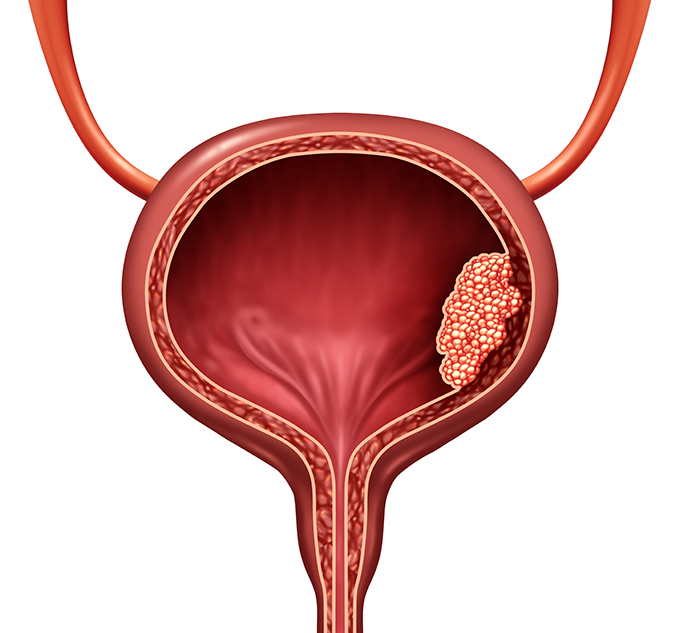
Bladder cancer most commonly arises from the urothelium — the lining cells of the bladder. Urothelial carcinoma (formerly called transitional cell carcinoma) accounts for over 90% of cases. Less common types include squamous cell carcinoma and adenocarcinoma.
Bladder cancer is classified as non-muscle-invasive (confined to the lining) or muscle-invasive (penetrating the bladder muscle). The two are treated very differently. Non-muscle-invasive is treated endoscopically with TURBT and often intravesical therapy. Muscle-invasive usually needs radical cystectomy with urinary diversion.
Risk factors include smoking (the single biggest), occupational chemical exposure, chronic bladder inflammation, and recurrent UTIs from certain organisms.
From hematuria
to confirmed diagnosis.
Step 1 — Urine analysis & cytology. Detects microscopic blood and abnormal cells.
Step 2 — Ultrasound KUB. May show a bladder mass but cannot exclude small tumours.
Step 3 — Cystoscopy. The definitive diagnostic test. A thin scope is passed through the urethra into the bladder under local anaesthesia. Any suspicious lesion is photographed and biopsied or scheduled for TURBT.
Step 4 — CT urogram. Imaging of the entire urinary tract — kidney, ureter, bladder — to rule out tumours elsewhere in the urothelium and to stage if a bladder tumour is found.
Step 5 — TURBT (Transurethral Resection of Bladder Tumour). Both diagnostic and therapeutic — the tumour is resected endoscopically and sent for histology to determine grade, stage, and muscle invasion.
Stage determines
everything.
Non-Muscle-Invasive
TURBT + intravesical BCG or chemotherapy + surveillance cystoscopy. The most common scenario.
Muscle-Invasive
Radical cystectomy + urinary diversion. Sometimes neoadjuvant chemotherapy first.
Locally Advanced
Radical cystectomy + extended lymph node dissection. Combined with chemotherapy.
Systemic Disease
Systemic chemotherapy and immunotherapy. Coordinated with medical oncology. Surgery for symptom control where appropriate.
Bladder cancer surgical
options.
TURBT (Transurethral Resection of Bladder Tumour) — The endoscopic removal of bladder tumours through the urethra. Both diagnostic and therapeutic for non-muscle-invasive cancer. Usually requires general or spinal anaesthesia. Hospital stay 1–2 days.
Intravesical Therapy — After TURBT for higher-risk non-muscle-invasive cancer, BCG (Bacillus Calmette-Guérin) or chemotherapy is instilled into the bladder weekly to prevent recurrence. Done in OPD over several weeks.
Radical Cystectomy with Urinary Diversion — Removal of the entire bladder, with urine drained either through an ileal conduit (urostomy bag) or a neobladder (internal pouch made from intestine that reconnects to the urethra). A major surgery with a 7–10 day hospital stay.
Lifelong care
for a recurrent
disease.
Surveillance protocol
Structured cystoscopy and cytology schedule, with reminders. We don't let follow-up slip.
Intravesical therapy in-house
BCG and chemotherapy instillation done at the clinic — no need to visit oncology for routine intravesical doses.
Radical cystectomy capability
For invasive cancers, full radical cystectomy with ileal conduit diversion. Coordinated with medical oncology for neoadjuvant or adjuvant chemotherapy.
Smoking cessation support
Smoking is the single biggest risk factor. We help every bladder cancer patient quit — this is part of the treatment.
Bladder cancer pricing.
| Procedure | Starting from |
|---|---|
| Initial consultation | ₹ [____] |
| Cystoscopy (diagnostic) | from ₹ [____] |
| TURBT | from ₹ [____] |
| Intravesical BCG (per dose) | from ₹ [____] |
| Radical cystectomy + ileal conduit | from ₹ [____] |
| Surveillance cystoscopy | from ₹ [____] |
Cashless treatment with all major insurers.
Most CGHS / ECHS / PSU panels supported. We handle pre-authorisation. Call +91 9509370455.
Bladder cancer —
your questions.
Painless blood in urine in adults — particularly smokers and people over 40 — needs evaluation, even if it only happened once and seemed to resolve. The first step is cystoscopy.
Only for muscle-invasive cancer (Stage T2+). Non-muscle-invasive cancer (Stage Ta, Tis, T1) is treated by TURBT and intravesical therapy — the bladder is preserved.
Bacillus Calmette-Guérin — the tuberculosis vaccine — is instilled into the bladder weekly after TURBT to stimulate immune attack on residual cancer cells. Highly effective for higher-risk non-muscle-invasive bladder cancer.
Two options. Ileal conduit — urine drains into a small bag attached to the abdomen. Neobladder — a pouch is made from intestine and connected to the urethra, allowing natural urination. The choice depends on cancer extent, anatomy, and patient preference.
Yes — high recurrence rate is the defining feature of non-muscle-invasive bladder cancer. About 50–70% recur. That's why surveillance cystoscopy continues for years.
Yes — and you should. Stopping smoking reduces the risk of recurrence. We support every patient through cessation as part of cancer treatment.
