
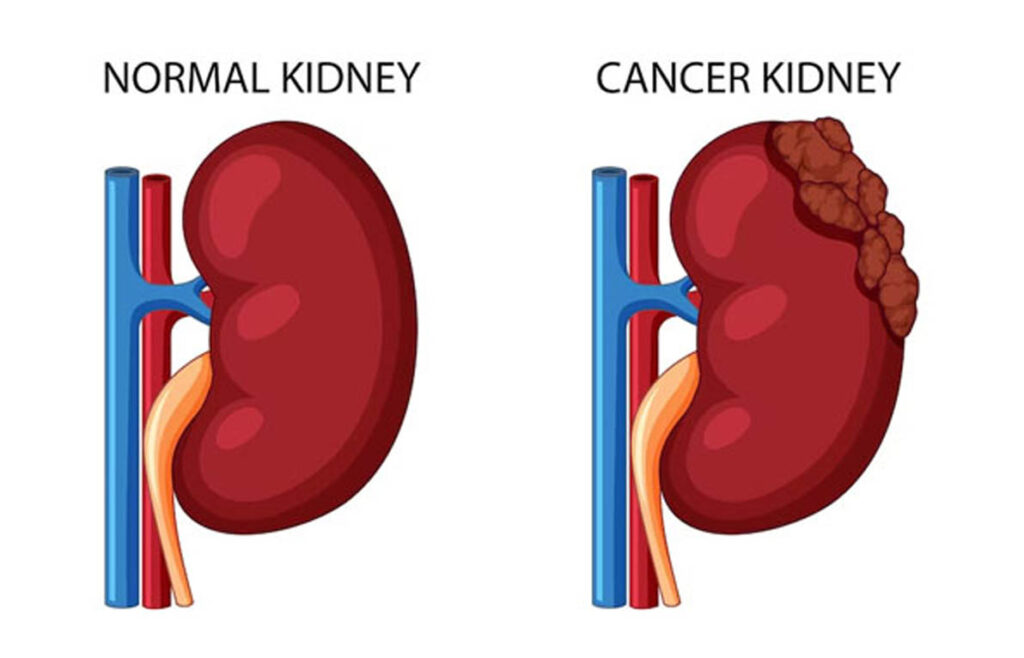
What is
kidney cancer?
Most kidney cancers in adults are Renal Cell Carcinoma (RCC) — a cancer that arises from the tubular cells of the kidney. Less common types include urothelial carcinoma (cancer of the renal pelvis lining), Wilms tumour (in children), and sarcomas.
Kidney cancer is often discovered incidentally — on ultrasound or CT done for another reason. When symptomatic, it can present with blood in urine, flank pain, a palpable mass, weight loss, or constitutional symptoms.
How kidney cancer
typically presents.
Often asymptomatic. Most modern kidney cancer is found incidentally.
When symptomatic, the classic triad (rarely all present):
- Blood in urine — visible or microscopic
- Flank pain — typically dull, persistent
- A palpable mass on examination
Other possible symptoms:
- Unexplained weight loss
- Persistent fever without infection
- Fatigue
- Anaemia or elevated red cell count (paraneoplastic)
- Elevated calcium (paraneoplastic)
- New-onset varicocele on the left side (suggests tumour extension into renal vein)
Surgery is usually
the answer.
Partial Nephrectomy
Removes only the tumour with a margin, preserves the rest of the kidney. Can be open or laparoscopic. Oncological outcomes equivalent to radical nephrectomy.
Radical Nephrectomy
Removes the entire kidney with surrounding fat and sometimes adrenal gland and lymph nodes. Often laparoscopic for tumours under 10 cm without invasion.
Ablation Techniques
Cryoablation or radiofrequency ablation for small tumours in patients unfit for surgery. Done at specialised partner centres.
Active Surveillance
For small tumours (under 3 cm) in elderly or unfit patients. Regular imaging instead of immediate surgery.
Systemic Therapy
Targeted therapy and immunotherapy have transformed outcomes for advanced RCC. Coordinated with medical oncology.
Kidney-preserving
where possible.
Partial nephrectomy capability
Not every urologist offers partial nephrectomy. It is technically harder than removing the kidney — but worth it for kidney function preservation.
Laparoscopic experience
VLD fellowship in advanced laparoscopy. Most kidney cancer surgeries under 10 cm done laparoscopically.
Multi-disciplinary coordination
Advanced or metastatic cancers — coordination with medical oncology for systemic therapy.
Long-term follow-up
Lifelong surveillance imaging protocols built into care.
Kidney cancer treatment pricing.
| Procedure | Starting from |
|---|---|
| Consultation | ₹ [____] |
| CT urogram (staging) | from ₹ [____] |
| Laparoscopic partial nephrectomy | from ₹ [____] |
| Open partial nephrectomy | from ₹ [____] |
| Laparoscopic radical nephrectomy | from ₹ [____] |
| Open radical nephrectomy | from ₹ [____] |
Cashless treatment with all major insurers.
Most CGHS / ECHS / PSU panels supported. We handle pre-authorisation. Call +91 9509370455.
Kidney cancer —
your questions.
Not necessarily. For small tumours (under 4 cm) and many tumours up to 7 cm, partial nephrectomy can remove the tumour while preserving the rest of the kidney. We always assess for partial nephrectomy first.
Yes — one healthy kidney provides adequate function for most patients. We monitor kidney function and blood pressure long-term.
CT scan of abdomen and pelvis, chest imaging, and blood work. Bone scan if symptoms suggest. PET scan in selected cases. Staging guides treatment.
Traditional chemotherapy has limited role in RCC. Modern targeted therapy and immunotherapy have transformed outcomes — coordinated with medical oncology.
For most kidney cancers, yes — oncological outcomes are equivalent with faster recovery and less pain. Very large or invasive tumours may need open surgery.
CT or ultrasound at 3, 6, 12 months in the first year, then 6-monthly to yearly. Long-term surveillance for at least 5–10 years depending on stage and grade.
