
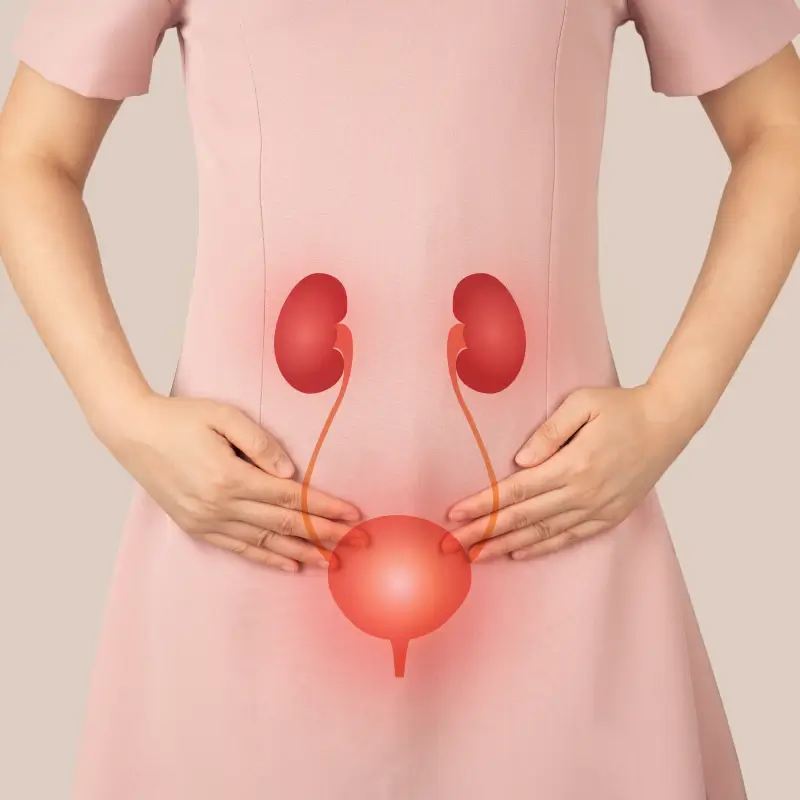
If you cannot urinate at all and your bladder feels painfully full — this is an emergency.
Don't wait. Don't drink more water. Don't try to push through it. Acute urinary retention needs catheterisation today, not tomorrow. Call +91 9509370455 first — we'll triage and arrange immediate relief. If we're closed and you're in severe pain, go to the nearest ER for a temporary catheter and follow up with us within 24 hours.
📞 Call Emergency LineWhat is
urinary retention?
Urinary retention is the inability to empty the bladder, fully or at all, despite the bladder being full. The urge is there. The mechanism isn't working. The urine has nowhere to go — and the pressure builds.
There are two clinical patterns, and they behave completely differently. Acute urinary retention is sudden — within hours you go from urinating normally to being unable to urinate at all. The bladder distends, the lower abdomen becomes painfully full, the urge is unbearable. This is a urological emergency. Chronic urinary retention is the opposite — it develops slowly over months or years. The bladder gradually loses tone and never empties completely. There is little pain, sometimes no symptoms at all, but the back-pressure can silently damage the kidneys.
In men, both are usually downstream of prostate enlargement (BPH) — the Prostate squeezes the urethra until eventually nothing can pass. In women, retention is far less common and usually has a neurological or anatomical cause. In both sexes, retention can be triggered by medications, surgery, anaesthesia, infection, or simply holding urine for too long after alcohol or a long flight.
Two patterns.
Different urgency.
Acute Urinary Retention
Develops over hours. Lower abdomen distended and painful. Cannot pass urine despite intense urge. Requires immediate catheterisation. Almost always followed by a workup for the underlying cause within the same week.
Chronic Urinary Retention
Develops over months or years. Often painless. Patient may not realise the bladder isn't fully emptying. Discovered when post-void residual is measured. Can damage kidneys if untreated.
Acute-on-Chronic Retention
A patient with long-standing chronic retention suddenly tips into complete blockage — often after a trigger like a UTI, constipation, or a new medication. Most common pattern in older men with BPH.
High-pressure Chronic Retention
The most dangerous form. Bladder pressure rises so high that urine backs up into the kidneys, causing hydronephrosis and progressive kidney damage. Often picked up on routine blood work showing elevated creatinine.
Why the
bladder stops emptying.
Urinary retention isn't really a diagnosis — it's a symptom. The clinical question is always why. In Jaipur, where BPH is widespread in older men and where heat and dehydration compound things in summer, the most common causes we see are:
In men:
- Benign Prostatic Hyperplasia (BPH) — by far the leading cause in men over 50. The enlarged prostate compresses the urethra until eventually it closes off.
- Prostate cancer — less common, but locally advanced prostate cancer can cause obstruction.
- Urethral stricture — scarring of the urethra from past catheterisation, infection, or trauma.
- Bladder neck obstruction — narrowing where the bladder meets the urethra.
- Bladder stones — large stones can act as a one-way valve, intermittently blocking the bladder outlet.
In women (less common):
- Pelvic organ prolapse pressing on the urethra
- Post-operative retention after gynaecological surgery
- Post-childbirth retention
- Urethral diverticulum or stricture
In both sexes:
- Medications — antihistamines, decongestants, certain antidepressants, anticholinergics, opioids, and some BP medications all reduce bladder contractility
- Neurological causes — diabetic neuropathy, multiple sclerosis, spinal cord injury, stroke, Parkinson's, prolapsed disc
- Recent surgery or anaesthesia — particularly spinal anaesthesia
- Severe constipation — a packed rectum can mechanically block the urethra
- UTI or prostatitis — sudden swelling can tip a borderline obstruction into complete retention
- Prolonged holding — flights, alcohol, social situations, long sleep — sometimes that alone is the trigger
What to do
in the next hour.
If you are reading this in pain, unable to urinate, with a full distended bladder — here is the practical sequence:
- 1. Do not drink more water. The instinct is to drink to "help things along." Don't. You are adding to a bladder that has nowhere to drain.
- 2. Do not take painkillers that delay things. Paracetamol is fine. Avoid anti-inflammatories, opioids, and any medication that contains anticholinergics — they make retention worse.
- 3. Call us first. +91 9509370455. If we are open, we can see you the same day and place a catheter at the clinic. The relief is almost instantaneous.
- 4. If we are closed, go to the nearest emergency room for a temporary catheter. Then call us within 24 hours for follow-up — the catheter is a holding measure, not the treatment.
- 5. Try not to drive yourself if you are in severe pain. Have someone bring you.
- 6. Bring all your current medications when you come in. The cause is often something on your prescription list.
After the catheter,
finding the cause.
The catheter is the first hour. The workup is the rest of the week. Once the immediate retention is relieved, we look at why it happened — because without addressing the cause, retention will recur, often within days of catheter removal.
Standard workup at Kalra Endo-Uro Care:
- Detailed history — duration of symptoms, prior episodes, medications, surgery history, trigger events
- Examination — including digital rectal examination in men to assess prostate size and texture
- Urine analysis & culture — to rule out infection
- Blood tests — creatinine and urea (to check kidney function — critical after retention), PSA in men, electrolytes
- Ultrasound KUB — bladder, kidneys, post-void residual measurement, prostate size
- Uroflowmetry — once the catheter is out and you can pass urine, this measures flow rate objectively
- Cystoscopy — in selected cases, to look directly at the urethra, prostate, and bladder for strictures, stones, or tumours
- Urodynamic studies — for neurogenic causes or unclear diagnoses
Within one or two visits we typically have a clear picture: the cause, whether further imaging is needed, and the appropriate treatment plan in writing.
Two stages —
relief, then resolution.
Urinary Catheterisation
A thin soft catheter is passed through the urethra into the bladder. Relief is immediate — typically within seconds. The catheter then drains continuously into a collection bag. Done at the clinic under local anaesthetic gel.
Suprapubic Catheter
If the urethra cannot be navigated (severe stricture, very large prostate), a small catheter is placed through the lower abdomen directly into the bladder under local anaesthesia and ultrasound guidance.
TURP or HoLEP
The definitive treatment for retention caused by BPH. Endoscopic surgery removes the obstructing prostate tissue. After surgery, normal urination is restored — usually permanently. More on prostate surgery →
Urethroplasty / Urethrotomy
For urethral strictures, the narrow area is either incised (urethrotomy) or surgically reconstructed (urethroplasty). Choice depends on length, location, and prior treatments.
Bladder Stone Removal
If a bladder stone caused the retention, it is removed by cystolitholapaxy — laser fragmentation of the stone through the urethra. Often combined with prostate surgery in the same anaesthetic. More →
Medication & Trial Without Catheter
For some patients, a 1–2 week course of alpha-blockers (tamsulosin) plus catheter removal — a "trial without catheter" — restores normal urination without surgery. We always attempt this where appropriate.
Acute relief.
Considered
follow-through.
Same-day catheterisation
When you call with acute retention during OPD hours, we see you the same day. No appointment runaround when you are in pain.
BPH surgery in-house
Most retention in men is BPH-driven. We perform both TURP and HoLEP — the gold-standard endoscopic prostate surgeries — in our own theatre.
Kidney function check, always
Severe retention damages kidneys. Every retention patient gets a creatinine check on day one. Recovery monitored over weeks.
Medication review built in
Many retention episodes are triggered by a new medication. We review your full prescription list, and where retention is medication-induced, we coordinate the change with your prescribing doctor.
Pricing for urinary
retention care.
| Service | Starting from |
|---|---|
| Emergency consultation + catheterisation | ₹ [____] |
| Suprapubic catheter (when needed) | from ₹ [____] |
| Workup (blood + urine + ultrasound) | from ₹ [____] |
| Uroflowmetry | ₹ [____] |
| Cystoscopy (diagnostic) | from ₹ [____] |
| TURP for retention | from ₹ [____] |
| HoLEP for retention | from ₹ [____] |
| Trial without catheter (review visit) | ₹ [____] |
Cashless treatment with all major insurers.
Emergency catheterisation and BPH surgery for retention are covered by all major Indian health insurers. We handle pre-authorisation paperwork. Call +91 9509370455 for a personalised estimate.
Urinary retention —
your questions.
Acute retention — within hours. If you cannot pass urine and your bladder is painfully full, you need a catheter the same day, not "wait and see." Chronic retention picked up on a routine check — within a week is reasonable.
Almost always temporary. The catheter relieves the immediate problem. The treatment plan — usually medications followed by surgery for BPH-driven retention — restores normal urination. Most patients are catheter-free permanently once treated.
Insertion is briefly uncomfortable — done with a lubricant gel containing local anaesthetic. The relief from a previously distended bladder is dramatic. Once in place, the catheter is bearable; most men can return to most activities.
After 1–2 weeks of medication (typically tamsulosin), we remove the catheter and see if you can urinate on your own. Many patients can — particularly those whose retention was triggered by infection, medication, or a one-off event rather than severe BPH.
Yes — particularly chronic high-pressure retention. The back-pressure of urine causes hydronephrosis (swelling of the kidneys) and progressive kidney damage. This is why we always check creatinine in retention patients, and why retention is never something to wait out at home.
If your retention is from BPH and you failed a trial without catheter, almost certainly yes. Modern options — TURP and HoLEP — are endoscopic, no open cuts, and very effective. After surgery, normal urination is usually restored permanently.
If you are in acute retention right now and far from Jaipur, go to your nearest hospital or ER for a temporary catheter immediately. Once the catheter is in and you are stable, you can travel safely. We will arrange follow-up and definitive treatment when you arrive — usually within 24-48 hours of you reaching Jaipur.
Yes — emergency catheterisation, workup, and any required surgery (TURP, HoLEP, urethroplasty, bladder stone surgery) are covered by all major Indian health insurers. We handle pre-authorisation.
