
High fever, severe back pain, vomiting, confusion, or low urine output — this is a urological emergency.
An infected obstructed kidney (pyonephrosis) can progress to sepsis within hours. If you have these symptoms, do not wait for the OPD — call +91 9509370455 immediately or go to the nearest ER. We can coordinate emergency drainage and admission.
📞 Call Emergency LineWhat is a
kidney infection?
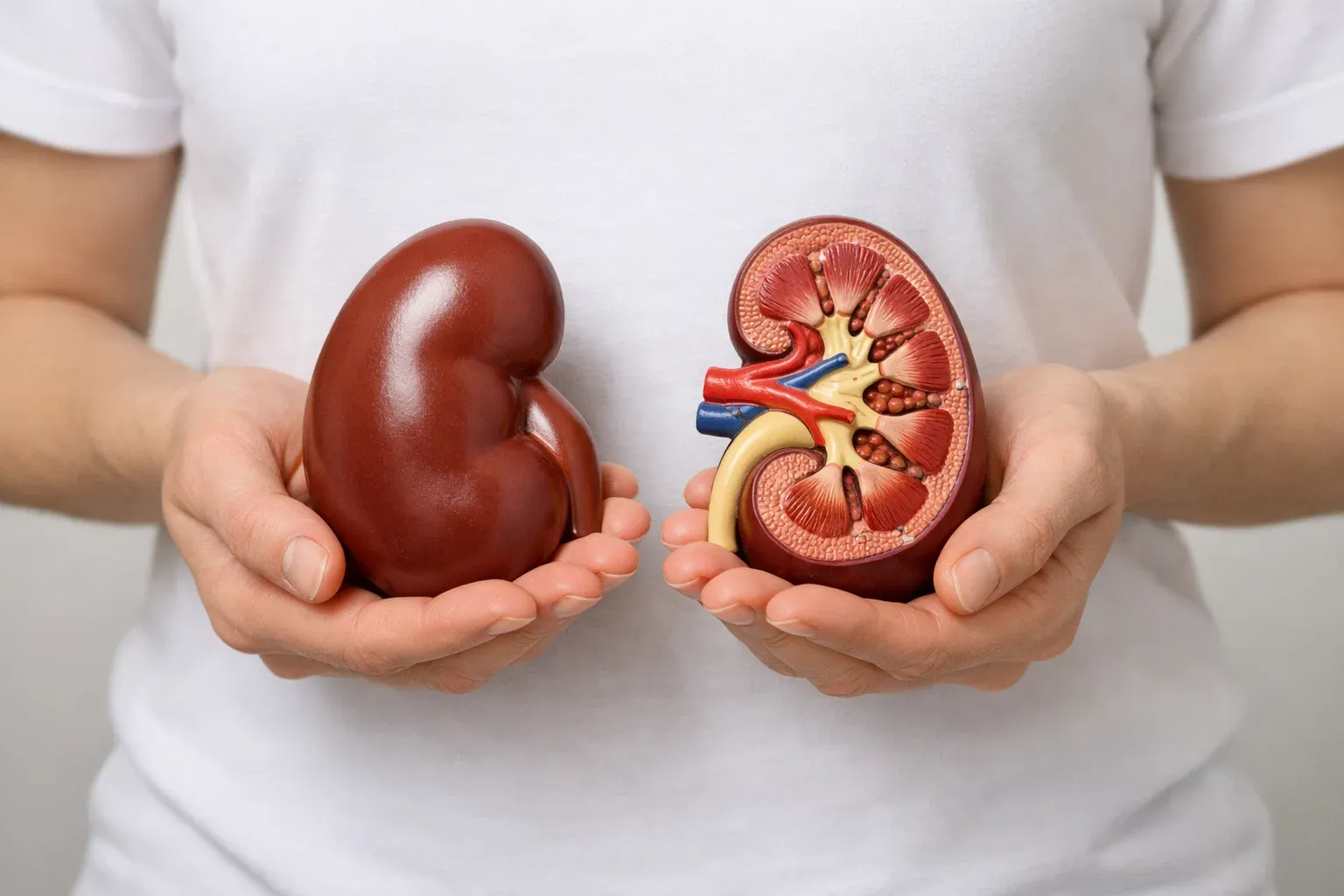
A kidney infection — medically called pyelonephritis — is a bacterial infection of one or both kidneys. It almost always starts as a urinary tract infection in the bladder that ascends up the ureter to the kidney. Less commonly, infection can reach the kidney through the bloodstream.
This is a fundamentally different disease from a simple bladder UTI. A bladder infection sits in the bladder lining and causes burning urination. A kidney infection inflames the kidney tissue itself, can cause sepsis, can scar the kidney, and can damage long-term function. Treating pyelonephritis as if it were just a stronger UTI — with the same short course of oral antibiotics — is a common and dangerous mistake.
Two clinical patterns exist:
- Acute pyelonephritis — sudden onset, severe symptoms, high fever, severe one-sided flank pain. Needs prompt treatment.
- Chronic pyelonephritis — long-standing or recurrent infections that scar the kidney over years. Often linked to underlying anatomical abnormalities or persistent reflux.
How a kidney infection
typically presents.
Kidney infection symptoms are more severe and more systemic than bladder infection symptoms. The classic combination:
- High fever, often with chills and rigors — temperature above 38.5°C is common
- Severe one-sided flank pain — felt high in the back or side, often radiating to the front
- Tenderness when the back is tapped — a positive renal angle tenderness on examination
- Nausea and vomiting — often severe enough to prevent oral fluids
- Cloudy, dark, or strong-smelling urine
- Frequent painful urination — the underlying UTI symptoms continue
- Fatigue and feeling generally unwell — like a serious flu
- Confusion or disorientation — particularly in elderly patients (a red flag for sepsis)
If you have flank pain plus fever, treat it as pyelonephritis until proven otherwise. Do not wait it out. Do not assume it's a stronger version of a bladder infection that will go away with the same tablets your wife took last year.
Who is at risk
and why.
Most kidney infections are caused by E. coli ascending from the bladder. Other organisms include Klebsiella, Proteus, Pseudomonas, and Enterococcus. Hospital-acquired or catheter-related infections may involve more resistant organisms.
Risk factors that increase your likelihood of pyelonephritis:
- Being female — shorter urethra means easier ascent of bacteria
- Pregnancy — hormonal changes and uterine pressure on the ureters slow urine flow
- Kidney stones — stones can harbour bacteria and obstruct urine drainage
- Vesico-ureteric reflux — backflow of bladder urine into the ureters
- Anatomical abnormalities — duplex systems, PUJ obstruction, ureteric strictures
- Indwelling catheters — long-term catheters are a major risk factor
- Diabetes — both increases susceptibility and worsens outcomes
- Immunosuppression — chemotherapy, transplant medications, advanced HIV
- BPH or bladder outlet obstruction — incomplete bladder emptying
- Dehydration — particularly in Jaipur summer, where outdoor workers are at high risk
- Recurrent UTIs — the more bladder infections you've had, the higher the cumulative risk
Three tests
that must be done.
A kidney infection deserves more than an empirical prescription. The standard workup at Kalra Endo-Uro Care:
- Urine analysis + microscopy — done on-site within minutes. Confirms white cells, bacteria, sometimes red cells. First evidence of UTI.
- Urine culture and sensitivity — sent to the lab. Results in 48–72 hours. Identifies the exact organism and which antibiotics will kill it. Empirical treatment is started immediately, then adjusted when results come back.
- Blood tests — full blood count (looks for raised white cells), creatinine and urea (assess kidney function), CRP (inflammation marker). In severe cases, blood cultures.
- Ultrasound KUB — same-day or next-day. Looks for stones , obstruction, hydronephrosis, abscess. Critical because an obstructed infected kidney is a surgical emergency.
- CT scan — in severe cases, recurrent cases, or where there's diagnostic doubt. Detects abscess formation and complications that ultrasound may miss.
- Further workup — for men, for recurrent pyelonephritis, or for unusual organisms — anatomical assessment including possibly cystoscopy or MAG3 scan.
Antibiotics first,
then the cause.
Treatment has three components, not one:
1. Antibiotics — the right ones, for the right duration.
- Mild to moderate pyelonephritis — oral antibiotics for 7–14 days. Initial empirical choice based on local resistance patterns (in Jaipur, increasingly we use fluoroquinolones, third-generation cephalosporins, or co-trimoxazole depending on the patient). Adjusted when culture results return.
- Severe pyelonephritis — admission for intravenous antibiotics for 48–72 hours, then switched to oral when fever settles. Total duration usually 10–14 days.
- Complicated pyelonephritis (obstruction, abscess, diabetic, immunocompromised) — IV antibiotics for longer, sometimes 14–21 days. Choice of agent reviewed daily.
2. Relieve obstruction if present. If imaging shows an obstructing stone or other blockage, the infection cannot be controlled by antibiotics alone — the obstruction must be relieved urgently. This is done with a DJ stent placement or a percutaneous nephrostomy, often same-day. This is the single most important factor in saving the kidney and preventing sepsis.
3. Treat the underlying cause — once the acute infection is controlled. If a kidney stone was the cause, removal is scheduled 4–6 weeks after the infection resolves. If BPH or urinary retention was the trigger, prostate treatment is planned. If a stricture was found, reconstruction is considered.
- Supportive care — adequate hydration (oral if possible, IV if vomiting), pain control, anti-emetics, fever management with paracetamol (avoid NSAIDs which can worsen kidney function during an infection).
What can go wrong
if treatment is delayed.
Sepsis
The infection spreads into the bloodstream. Causes severely low blood pressure, organ dysfunction, confusion. Can be fatal. Treated in ICU with aggressive fluid resuscitation and IV antibiotics.
Pyonephrosis
An infected obstructed kidney filled with pus. Needs emergency drainage with a percutaneous nephrostomy within hours. Failure to drain promptly risks losing the kidney.
Renal Abscess
A pocket of pus within or around the kidney. May need image-guided drainage in addition to antibiotics. Usually found on CT scan.
Renal Scarring
Repeated or severe pyelonephritis leaves scars in the kidney that gradually reduce function. Long-term consequence of recurrent or inadequately treated infections.
Premature Labour
Pyelonephritis in pregnancy raises the risk of premature labour and low birth weight. Aggressive early treatment is essential.
Chronic Pyelonephritis
Repeated infections over years cause progressive kidney damage. Treatment requires not just antibiotics but identification and correction of the underlying cause.
Reducing
recurrence.
After one episode of pyelonephritis, the priority is preventing the next. Three lines of defence:
- Treat the underlying cause — stones, BPH, strictures, reflux. Without this, infections come back.
- Adequate hydration — particularly important in Jaipur. 2.5–3 litres of water daily, more in summer or if working outdoors. Pale yellow urine is the target.
- Complete bladder emptying — don't hold urine for long periods. Double-void (urinate, wait two minutes, urinate again) if you have any incomplete-emptying tendency.
- Post-coital urination — particularly for women prone to UTIs.
- Treat constipation — a packed colon affects pelvic floor function and bladder emptying.
- Control diabetes — high blood sugar increases susceptibility dramatically.
- Prophylactic antibiotics in selected cases — for recurrent pyelonephritis, sometimes a low-dose nightly antibiotic for 6 months breaks the cycle.
- Vaginal estrogen in post-menopausal women — restores the vaginal flora and reduces UTI recurrence rates significantly.
- Cranberry products or D-mannose — modest evidence in some patients.
Treat the infection.
Find the cause.
Protect the kidney.
Culture-driven antibiotic choice
Every patient gets a urine culture — not just empirical antibiotics that may or may not work against your specific organism. Resistance is rising in Jaipur; this matters.
Same-day imaging
Ultrasound the same day to rule out obstruction. CT if needed. We don't treat pyelonephritis without knowing whether there's a stone or abscess.
Emergency drainage capability
If an obstructed infected kidney is found, we can place a percutaneous nephrostomy or DJ stent same-day. Speed determines whether the kidney is saved.
Definitive cause treatment
Stone removal, prostate surgery, stricture repair — the underlying urological causes are treated under one roof. Without this, infections recur.
Pricing for kidney
infection care.
| Service | Starting from |
|---|---|
| Consultation + urine analysis | ₹ [____] |
| Urine culture & sensitivity | ₹ [____] |
| Blood workup (CBC, CRP, creatinine) | from ₹ [____] |
| Ultrasound KUB | from ₹ [____] |
| CT KUB (if needed) | from ₹ [____] |
| Outpatient treatment course (full) | from ₹ [____] |
| Admission + IV antibiotics (per day) | from ₹ [____] |
| Emergency DJ stent / nephrostomy | from ₹ [____] |
Cashless treatment with all major insurers.
Admission for severe pyelonephritis and any procedural intervention (stenting, nephrostomy, stone surgery) is covered by all major insurers. Outpatient cases may be self-pay depending on policy. We handle pre-authorisation.
Kidney infection —
your questions.
A urinary tract infection (UTI) usually refers to a bladder infection — burning urination, frequency, urgency, lower abdominal discomfort. A kidney infection (pyelonephritis) involves the kidney itself — high fever, severe flank pain, vomiting, systemic illness. Pyelonephritis is more serious, harder to treat, and needs longer antibiotic courses.
Mild cases yes — oral antibiotics, plenty of fluids, pain control. Severe cases (high fever, vomiting, unable to keep fluids down, diabetic, pregnant, elderly, or with abnormal imaging) need admission for IV antibiotics. Imaging to rule out obstruction is essential before any home treatment is started.
Fever and severe symptoms usually settle within 48–72 hours of starting the right antibiotic. Full recovery takes 10–14 days for most patients. Underlying causes (stones, prostate, strictures) need to be addressed separately, usually 4–6 weeks after the acute infection.
Usually not, if treated promptly and adequately. A single episode of acute pyelonephritis treated within 24–48 hours rarely causes long-term damage. Delayed treatment, obstruction, abscess, or recurrent infections can leave permanent scarring.
To check for an obstruction (usually a stone) or abscess. An infected obstructed kidney needs urgent drainage and is treated very differently from a simple kidney infection. Imaging is standard practice in pyelonephritis.
Yes — but it's uncommon in men. A kidney infection in a man almost always indicates an underlying urological cause — enlarged prostate, kidney stone, anatomical abnormality. Every man with pyelonephritis needs a full urological workup.
Untreated pyelonephritis in pregnancy is risky — it increases the chance of premature labour and low birth weight. With prompt appropriate treatment (usually admission for IV antibiotics), outcomes for mother and baby are excellent. We coordinate with your obstetrician.
Treat the underlying cause if there is one (stone, prostate, stricture). Drink enough water (2.5–3 litres daily). Empty bladder fully. Treat diabetes. For recurrent cases — prophylactic antibiotics, vaginal estrogen in post-menopausal women, or other measures based on individual risk factors.
